
Counting is presently constructed on the principle of balance. Consistent with what we observe when an animal moves from a first field to a second, counting is treated as if a distinct (countable) object moves from an uncounted set to a counted set. There is one object (1). It is the same before and after it has been counted (1 = 1). It is subtracted from the uncounted set (1 – 1 = 0) and added to the counted set (0 + 1 = 1). Consistent with what is observed with the animal being subtracted from the field and added to the next, the two actions are deemed to be synchronized in time. Were that not to be the case, the distinct object (animal) could temporarily be lost (subtraction first) or duplicated (addition first). The complete counting process, closure, involves two steps.
Counting as we understand it today appears to involve three elements – the distinct (countable) object (1), the uncounted set, and the counted set – but it also implicitly relies on a fourth: the logic controller (0), which governs the balance between them. It relates the distinct (countable) object (1) to 0 through the principle of balance (1 – 1 = 0 – 0 = 0, and so on).
But what if counting were not about moving isolated objects between sets, but about closing cycles of relationships?
Chiralkine treats all objects as relational, based on the mirror symmetry of Order 4. Each object is defined by drawing a distinction between what it is and is not, and the mirror symmetry inherent in Order 4 constrains how these distinctions can be redrawn – it couples the sides of the distinctions together, so that they rotate together in rings.
Chiralkine counting treats all objects as relational distinctions – not as isolated units. It reforms the four objects identified in the conventional view of counting into four relational oppositional pairs. The same functional roles are preserved – three active relational distinctions and one governing logic frame – but now each is defined symmetrically.
While closure in conventional counting completes in two steps (subtracting from an uncounted set and adding to a counted set), closure in chiralkine counting requires three synchronized steps through relational pairings, reflecting the symmetry of Order 4. This extra step ensures not just numerical balance, but relational integrity: meaning is preserved as a relationship, not lost in the abstraction of equals signs.

Chiralkine can be used to count a quantity (#) of objects (1, 2, 3, 4 . . . #). Each object is a relationship created by drawing distinction between what it is and is not. The quantities of “is” and “not” are the same, so there are (#) “is” and (#) “not”. Each object can be counted only once. So every object can be associated with two different numbers selected from (1, 2, 3, 4 . . . #), one for “is” and one for “not”. Counting then proceeds by linking objects pairwise through like numbers, 1 with 1, 2 with 2, 3 with 3, up to # with #, at which point a ring is formed. All of the objects are now associated with the same number for “is” as “not” and the distinction between counted and uncounted has been cleared.
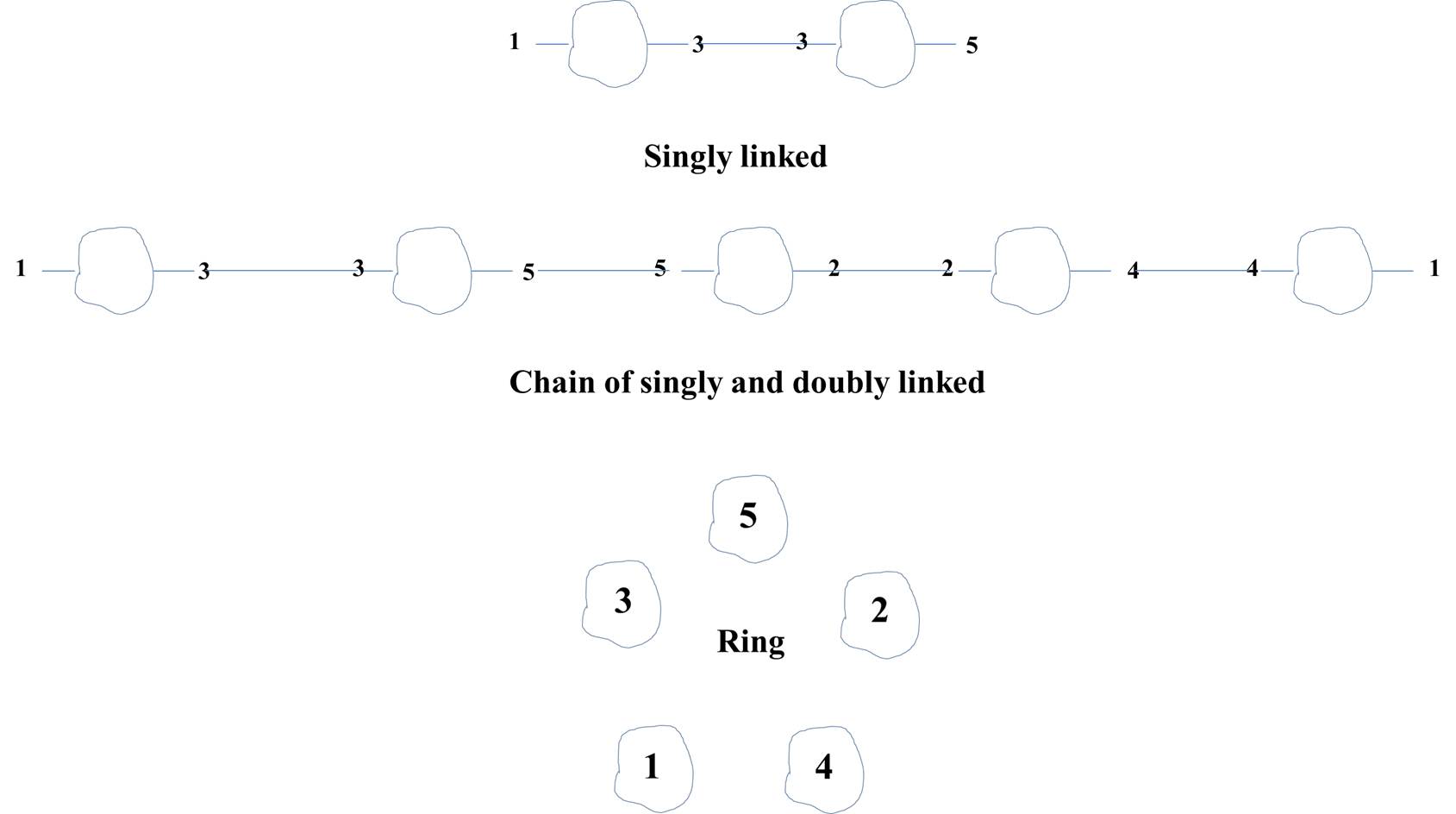
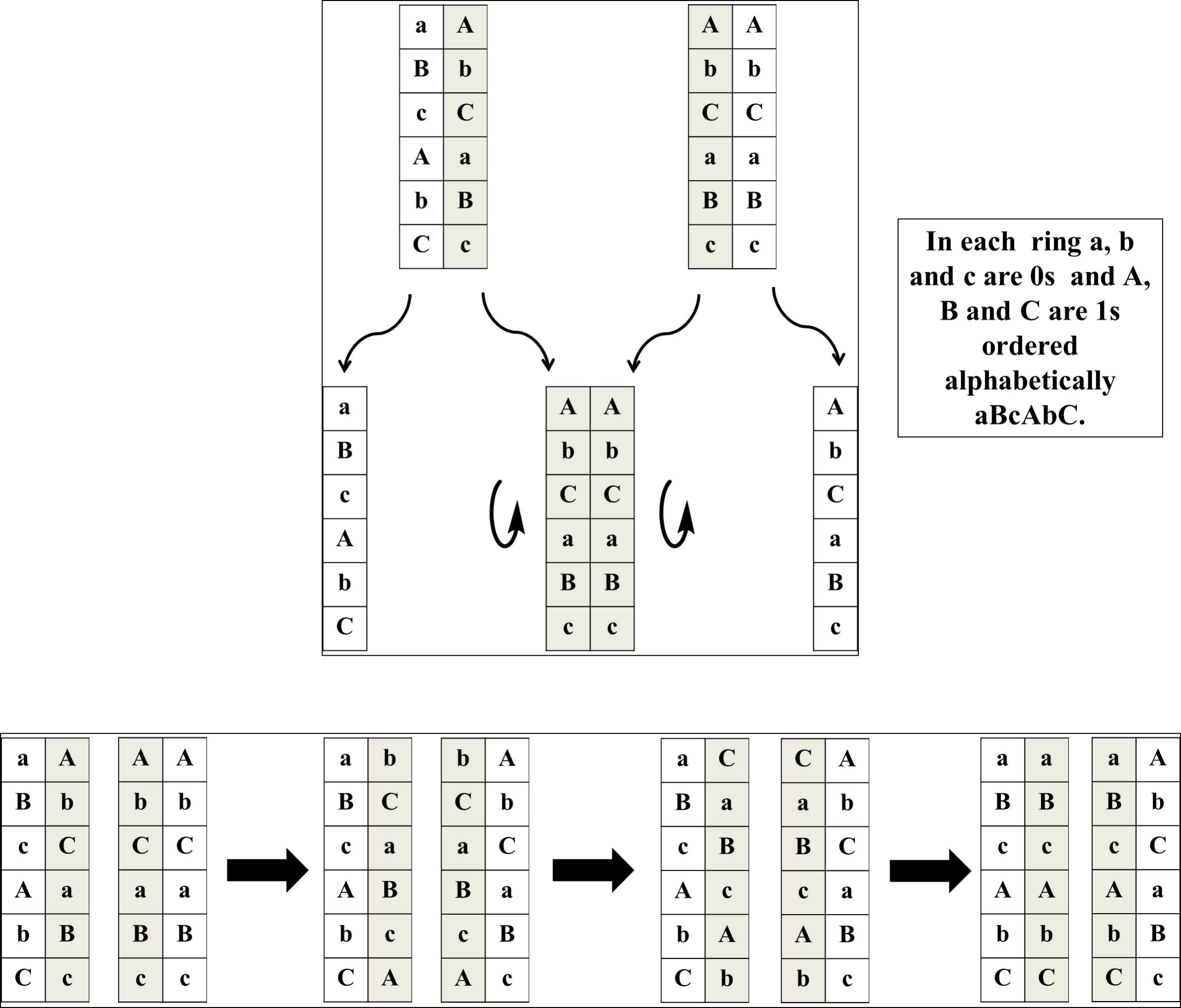
Before counting starts and after it has been completed, the objects are indistinguishable. They are in a ring. During counting symmetry is broken, so objects are distinguishable in the sense that they can be connected once or twice. Chiralkine tracks this. Objects in a ring are all in mirrored states aA and AA. Objects with one link are in mirrored states ab and bA. Objects with two links are in mirrored states aC and CA. Counting is complete when mirrored states aA has switched to state aa, clearing the distinction between counted and uncounted, and mirrored state AA has switched to aA.
A quantity (#) consists of # objects, each defined by a distinction being drawn between what it is and is not: # is and # not, but the quantity (#) is also an object defined by a distinction being drawn between what it is and is not. Hence 4 at the end of a count 1, 2, 3, 4 is different from 4 during a count 1, 2, 3, 4, 5. The two 4s differ in symmetry. Quantity (#) behaves as frequency.
To understand this intuitively, think about how a bank creates money (+1) and debt (-1) to enable one person to buy something from another. The money (+1) and debt (-1) are created out of nothing (0), based on the principle of balance. This constitutes two coupled counting steps: addition of 1 to seller and subtraction of 1 from the buyer. When the buyer pays off the debt by selling something to someone else, there are two more coupled counting steps: subtraction of 1 from that someone else and addition of 1 to the buyer. When the seller uses the created money to buy something from another person, there are two more coupled counting steps: subtraction of 1 from the seller and addition of 1 to that another person. There is no relational closure as between the seller and the buyer until they have both returned to 0, and indeed there has been no relational closure across the exchange system as a whole until a ring has been formed where the “someone else” and the “another person” are one and the same. Operating on the principle of balance allows the buyer and seller to cancel what are mirror opposite obligations independently. Three steps are required for relational closure. Failure to ensure relational closure can, over repeated counting steps result in some exchange participants accumulating more money (+1) than others.
The process of counting can also be understood with reference to coupled rotations of chiralkine rings.

The key is that the “quantity being counted” exists at all times during the counting process – in the counted set, in the uncounted set and in between while counting is progressing. It is one side of a relational object. If the quantity being counted is five, there are five mirror pairs of chiralkine rings that have to rotate as counting progresses – 1, 2, 3, 4, 5. To develop intuition for this, think of an irrational number such as π (pi). The circumference of a circle of radius r is 2πr. The ratio of the radius to the circumference is irrational – each can be a countable quantity, but not both at the same time. The mirror symmetry that controls the drawing of distinctions prohibits this.
Counting performed on the principle of an equation is incomplete. Therein lies a fundamental cause of problems now manifesting in the relationships between people and in their collective relationship with the planet – the natural world.