
In equation-based mathematics a distinction is drawn between two kinds of mathematical object, real (±1) and imaginary (±√-1. The two oppositional (+ and -) forms of each kind mutually negate to a third mathematical object, nothing (0), which transcends the distinction drawn between the other two kinds of mathematical object.
The three kinds of mathematical object constitute an artefact of working on the principle of a balance. Properly there are three oppositional pairs of relational mathematical object constituted in the symmetry of Order 4.
All of the kinds of mathematical object are outputs from four input pairs (01 or -+, 10 or +-, 11 or ++ and 00 or –). Distinctions are drawn using the truth tables for XOR and its mirror opposite XNOR.
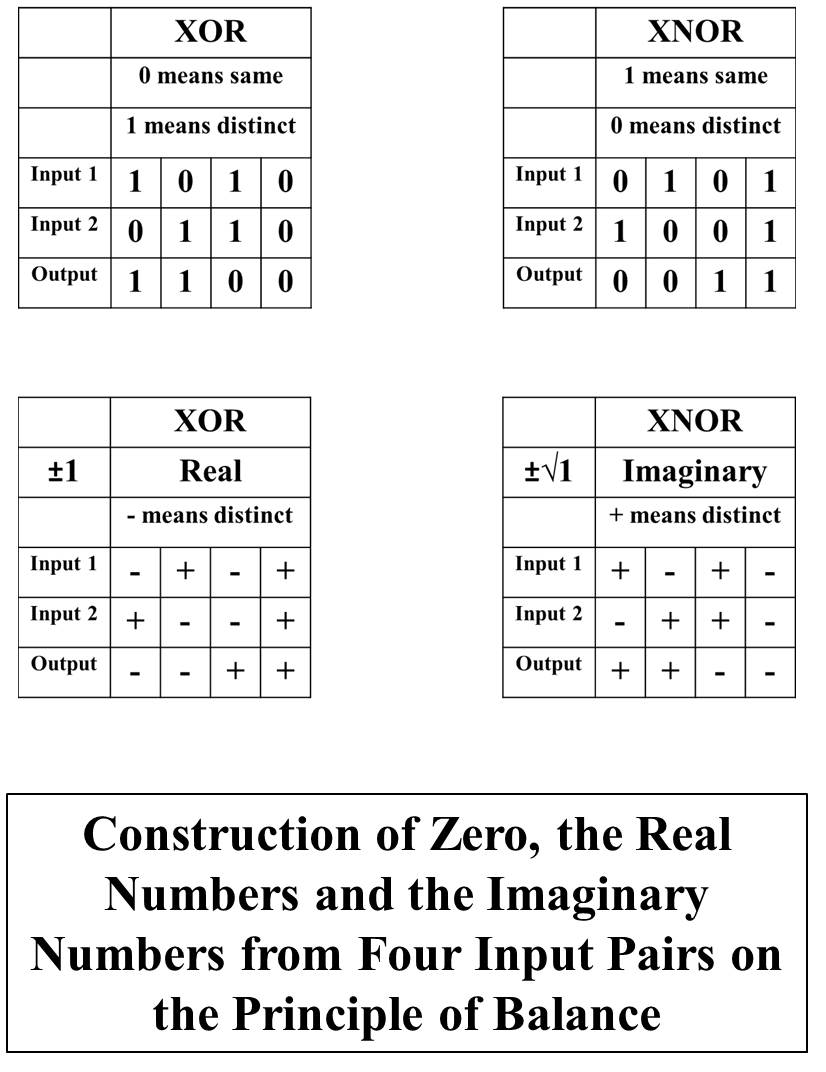
There are six possible ways of ordering four objects, and hence the four input pairs, in rings (Order 4). This forces the truth table for XOR and XNOR to interpenetrate, such that the meanings of 1 and 0 oscillate relationally.
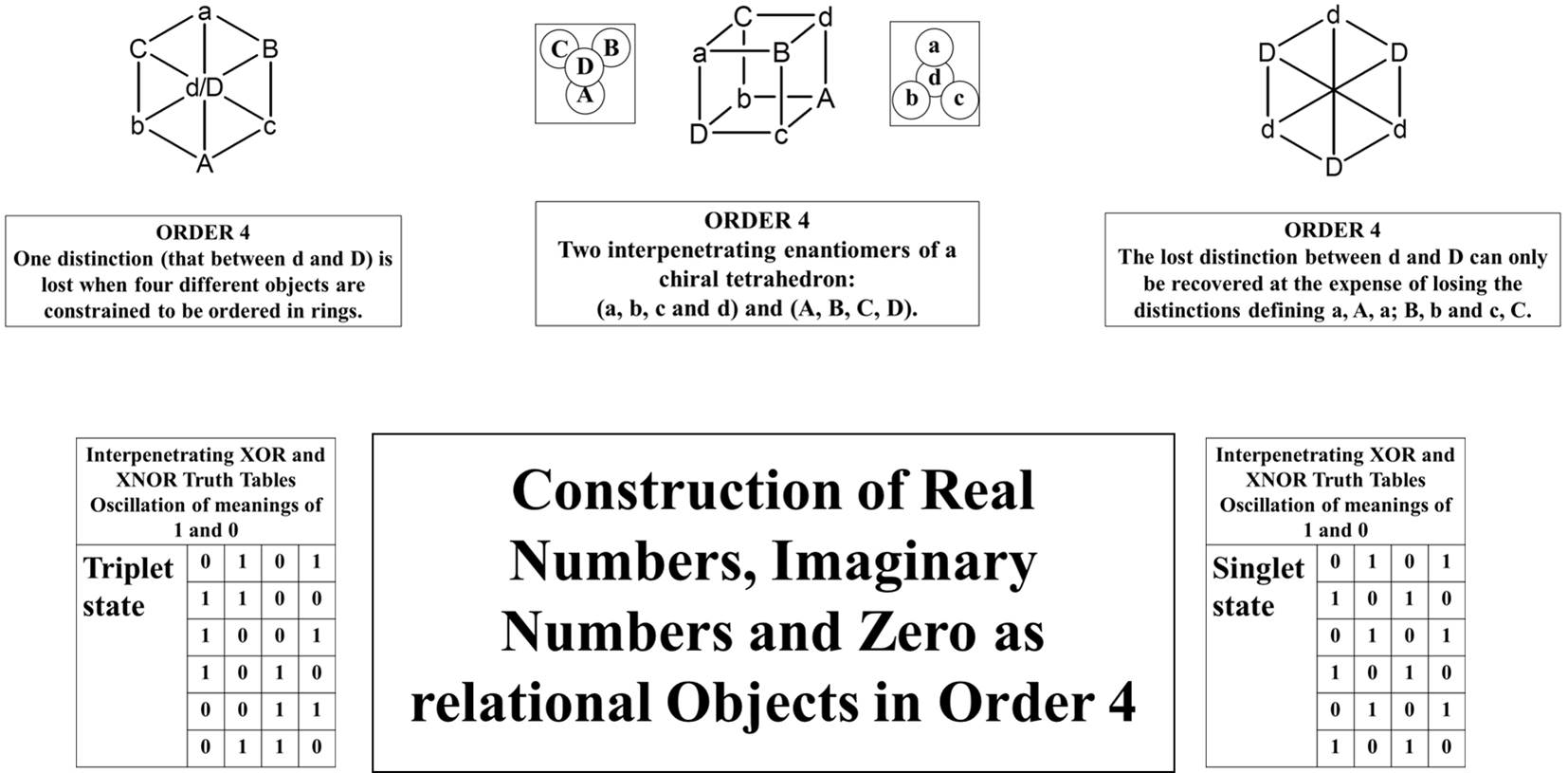
This relational reconstruction redraws the distinctions defining zero, real and imaginary
mathematical objects to create three symmetrical oppositional pairs of relational
mathematical objects that behave like an oppositional pair of zeroes (a, A), an oppositional
pair of real numbers (B, b) and an oppositional pair of imaginary numbers (c, C). In effect it
integrates zero, real and imaginary numbers into a relational cycle, for example from (a, A) to
(A, a), analogous to the creation and redemption of money and debt from balance (zero) in a
cycle of exchange of goods and services.
(a,A) → (B, b) → (c, C) → (A,a)
(0) → (+1, -1) → (0)